Catch up bookkeeping services give small business owners a clear, accurate financial picture after months or even years of neglected records. Whether receipts piled up in a drawer or a previous bookkeeper left transactions uncategorized, these services rebuild your books from the ground up so you can file taxes, secure financing, and make confident decisions again. For Minneapolis business owners juggling payroll, compliance, and daily operations, falling behind on bookkeeping is common. However, catching up does not have to feel overwhelming when you work with the right team.
Direct answer: Catch up bookkeeping services are professional processes that reconstruct months or years of missing, disorganized, or inaccurate financial records into clean, reconciled books. In practice, an accountant gathers your statements, categorizes transactions, corrects errors, and produces updated reports so your business is current and audit ready.

Getting organized is the first visible sign that catch up bookkeeping services are working.
What Are Catch Up Bookkeeping Services?
In short, catch up bookkeeping services take financial records that are behind, incomplete, or riddled with errors and bring them fully current. Specifically, a bookkeeper reviews every bank statement, invoice, and receipt from the missed period, then reconciles them against your accounting system. As a result, you end up with an accurate profit and loss statement, balance sheet, and cash flow report instead of guesswork.
This work matters because most tax preparers and lenders will not act on unreliable numbers. For example, the U.S. Small Business Administration notes that consistent recordkeeping is one of the core habits behind sustainable small business growth, and the IRS requires supporting documentation for every deduction claimed on a return.
Signs Your Books Need a Bookkeeping Cleanup
Many business owners do not realize how far behind their records are until a lender, auditor, or tax deadline forces the issue. In particular, a bookkeeping cleanup usually becomes necessary when one or more of the following signs appear.
- Bank accounts have not been reconciled in three or more months.
- You cannot answer a basic question about current cash flow.
- A previous bookkeeper left mid-project without finishing categorization.
- Payroll records and tax filings do not match your bank statements.
- You are applying for a loan or grant and cannot produce current financials.
If any of these sound familiar, waiting longer only makes the eventual cleanup more time-consuming and expensive.
How the Catch-Up Bookkeeping Process Works
Although every firm structures the work slightly differently, a reliable catch-up bookkeeping process generally follows the same core sequence. Below is the typical order of operations a bookkeeper follows to bring your books current.
- Gather every financial document. Collect all bank statements, credit card statements, invoices, receipts, and payroll records for the entire period that has fallen behind so nothing is missing during reconciliation.
- Reconcile bank and credit card accounts. Match every transaction against your accounting software to identify duplicates, missing entries, and unexplained discrepancies that need correction.
- Categorize and correct transactions. Assign each transaction to the correct expense or income category, fix miscoded entries, and flag anything that requires the business owner's input.
- Generate updated financial reports. Produce a current profit and loss statement, balance sheet, and cash flow report so you finally have an accurate picture of performance.
- Set up ongoing bookkeeping systems. Establish a monthly reconciliation schedule and connect bank feeds so the business does not fall behind again.
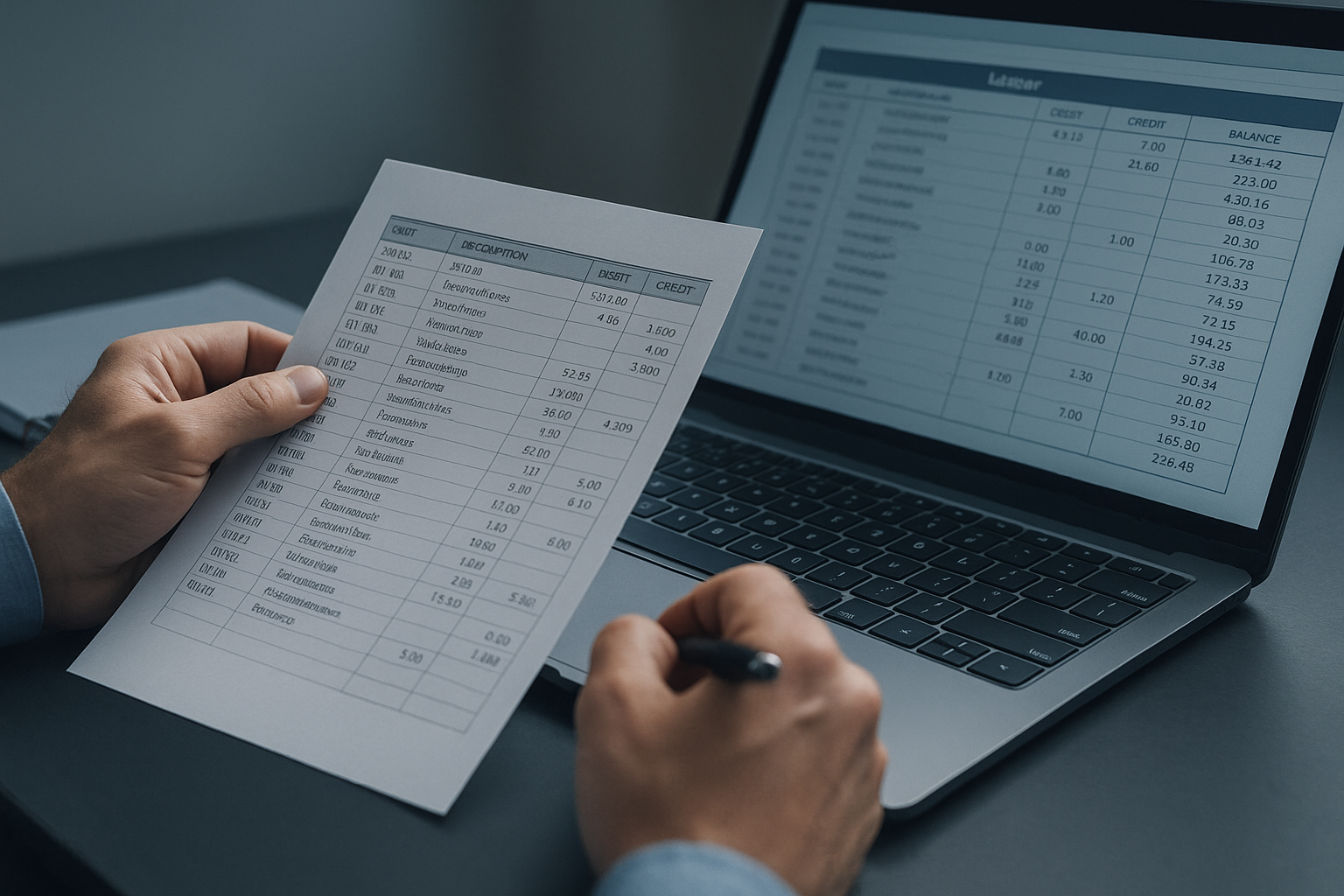
Reconciliation is the backbone of any bookkeeping cleanup, matching every transaction line by line.
Why Overdue Books Cost Your Business More Than You Think
Overdue books rarely stay a minor inconvenience for long. Instead, they quietly compound into missed deductions, inaccurate tax filings, and blind spots around cash flow. According to IRS recordkeeping guidance, businesses must retain supporting documentation for income and expenses, and gaps in those records can lead to disallowed deductions during an audit.
Consequently, the cost of staying behind is rarely just the bookkeeper's invoice. HAR Financial Services, for example, has helped clients secure more than one million dollars in grants and loans, a figure that depends entirely on lenders receiving accurate, current financial statements. Without clean books, that kind of funding simply is not available.
By the numbers: HAR Financial Services has served more than 600 clients over 20 years, migrated 240 payroll clients to a new processor with zero missed payrolls, and helped clients secure over $1,000,000 in grants and loans.
Compliance and Cleanup Support for DHS-Licensed Providers
Minnesota's DHS-licensed home care and waivered service providers face a compliance burden that goes well beyond typical small business bookkeeping. Reevaluations, DWRS rate audits, background study requirements under NETStudy 2.0, and 245D or 245A licensing rules all depend on financial records being current and defensible. In this niche, a bookkeeping cleanup is not optional; it is a licensing requirement.
HAR Financial Services already supports providers through these exact requirements, from rate audit appeals to corrective action plans. As a result, DHS-licensed operators who fall behind on records have a firm nearby that already understands the rules rather than one learning them for the first time.
Choosing a Provider for Back Bookkeeping Services
Not every firm handles back bookkeeping services the same way. Some offshore providers move quickly and price aggressively, but they often rotate staff and offer little direct access to the person actually doing the work. In contrast, a local firm with a physical office lets you sit down with the bookkeeper handling your account.
HAR Financial Services, based in a recently renovated Minneapolis office at 2304 Park Ave S, offers free catch-up bookkeeping consultations and an accuracy guarantee, with no charge until after the first meeting. You can explore HAR Accounting's bookkeeping services directly to see how the process starts. For businesses that want ongoing support beyond the initial cleanup, the firm also offers payroll, tax preparation, and CFO-level advisory under one roof, which means you are not juggling separate vendors who do not talk to each other.
Furthermore, membership in professional bodies such as the American Institute of Professional Bookkeepers signals a baseline of training and ethics worth checking before hiring any firm. Above all, ask any prospective provider how they would handle a transition, since a smooth migration is the clearest evidence of real operational discipline.
Common Mistakes to Avoid When Catching Up Your Books
Even well-intentioned business owners tend to repeat the same errors during a financial catch-up. In particular, mixing personal and business expenses makes reconciliation far harder than it needs to be. Similarly, ignoring small transactions because they seem insignificant often hides the exact errors that cause discrepancies later.
Another frequent mistake is attempting a do-it-yourself catch-up without reconciling every single bank statement, which leaves gaps that surface again at tax time. Therefore, it is usually faster and cheaper in the long run to bring in a bookkeeper once records exceed a month or two behind, rather than trying to close a much larger gap alone.

Reviewing finished reports together confirms the catch-up bookkeeping process is complete and accurate.
Frequently Asked Questions About Catch Up Bookkeeping Services
What are catch up bookkeeping services?
Catch up bookkeeping services are professional processes that bring months or years of neglected financial records current by reconciling accounts, categorizing transactions, and correcting errors. They give business owners accurate books they can use for taxes, loans, and decision-making.
How long does catch up bookkeeping take?
Most catch-up projects take between two and eight weeks, depending on how many months of records need review and how organized the original documents are. A single missed quarter is usually faster to resolve than several years of neglected books.
How much do catch up bookkeeping services cost?
Pricing usually depends on transaction volume and how far behind the books are, with many firms charging per month of cleanup needed. At HAR Financial Services, ongoing bookkeeping typically runs around 500 dollars per month, and catch-up work is scoped after a free consultation.
What happens if I never catch up on my bookkeeping?
Falling further behind makes tax filing inaccurate, hides cash flow problems, and can trigger penalties if agencies request records you cannot produce. Lenders and grant programs also tend to reject applications without current financial statements.
Can catch up bookkeeping services help with overdue tax filings?
Yes, accurate catch-up bookkeeping is usually the first step before a tax preparer can file overdue or amended returns correctly. Without clean books, tax filings risk missing deductions or reporting incorrect income.
What documents do I need to start a bookkeeping catch-up?
You typically need bank and credit card statements, payroll records, invoices, receipts, and any prior tax returns for the period in question. Providing digital copies speeds up the reconciliation process significantly.
How is catch-up bookkeeping different from regular monthly bookkeeping?
Regular bookkeeping keeps current records updated in real time, while catch-up bookkeeping reconstructs past periods that were never properly recorded. Once caught up, most businesses move into an ongoing monthly service to avoid falling behind again.
What mistakes should I avoid during a bookkeeping catch-up?
Common mistakes include mixing personal and business expenses, ignoring small transactions, and attempting a catch-up without reconciling every bank statement. Skipping professional review often produces reports that cause problems later.
Can catch up bookkeeping services fix errors left by a previous bookkeeper?
Yes, a qualified firm can review prior entries, identify miscategorized transactions, and correct them during the catch-up process. This is one of the most common reasons business owners switch providers.
Do I still need catch up bookkeeping if I use accounting software?
Software only organizes what is entered correctly, so unreconciled or miscategorized transactions still need professional cleanup. Automation reduces manual work, but it does not replace human review during a catch-up project.
How do DHS-licensed providers benefit from catch up bookkeeping services?
DHS-licensed home care and waivered service providers face DWRS rate audits and licensing reviews that require accurate, current financial records. Catching up on bookkeeping ensures they can respond to reevaluations and compliance requests without delay.
What should I look for in a catch up bookkeeping provider?
Look for a firm with direct access to the person handling your books, experience in your industry, and a clear process for reconciling historical records. Local firms with a physical office, such as HAR Financial Services in Minneapolis, offer accountability that fully remote providers may not.
Final Thoughts on Getting Your Books Current
Ultimately, catch up bookkeeping services exist to turn financial chaos into clarity, whether you are months behind or facing a licensing audit with no warning. As shown above, the process follows a predictable path: gather records, reconcile every account, correct errors, and rebuild reports you can actually trust. For a deeper look at recordkeeping standards, the Wikipedia overview of bookkeeping and the SBA's financial management guide both offer useful background.
In the end, the businesses that recover fastest are the ones that stop waiting and start the cleanup. If your records have fallen behind, schedule a free consultation with HAR Financial Services or visit HAR Accounting online to see how a 20-year Minneapolis firm handles catch up bookkeeping services from the first phone call to the finished report.
