A Minneapolis business payroll provider is the company or team responsible for calculating wages, withholding taxes, and filing the payroll paperwork that keeps employees paid correctly and on time. For owners juggling hiring, cash flow, and daily operations, picking the right payroll partner matters far more than it might seem at first glance. This guide explains what a payroll provider actually does, how to evaluate one, and what Minneapolis and Wisconsin businesses — including Minnesota DHS-licensed providers — should expect from a firm that handles payroll alongside bookkeeping and tax planning.

Payroll compliance work for a Minneapolis business payroll provider often happens in person, not through a call center.
What Is a Minneapolis Business Payroll Provider?
A Minneapolis business payroll provider is an accounting or bookkeeping firm that processes employee wages, withholds and deposits payroll taxes, and files the required reports with state and federal agencies. Many providers also manage direct deposits, new-hire reporting, unemployment insurance accounts, and year-end W-2 or 1099 filings. In short, the provider takes on the repetitive, compliance-heavy work so the business owner doesn't have to.
For example, HAR Financial Services currently runs payroll for roughly 240 active clients through its own HARpay platform. Consequently, when the payroll processor Kotapay shut down without warning, HAR migrated every one of those 240 clients to NatPay with zero missed payrolls and zero compliance gaps. That kind of transition is a real-world test of what a dependable payroll provider should deliver when something breaks behind the scenes.
Why Local Payroll Support Matters in Minneapolis and Wisconsin
Minnesota and Wisconsin each have their own unemployment insurance rates, withholding tables, and filing deadlines. As a result, a payroll services provider that only understands federal rules can easily miss a state-specific requirement. In addition, businesses with employees on both sides of the St. Croix River need a provider comfortable filing across two states without creating gaps.
Local presence also changes how quickly problems get solved. HAR's team works in person from a renovated office at 2304 Park Ave S in Minneapolis, which means clients talk to the same person every time instead of a rotating call center queue. Therefore, a payroll question that might take days to resolve through a national service can often get answered the same afternoon.
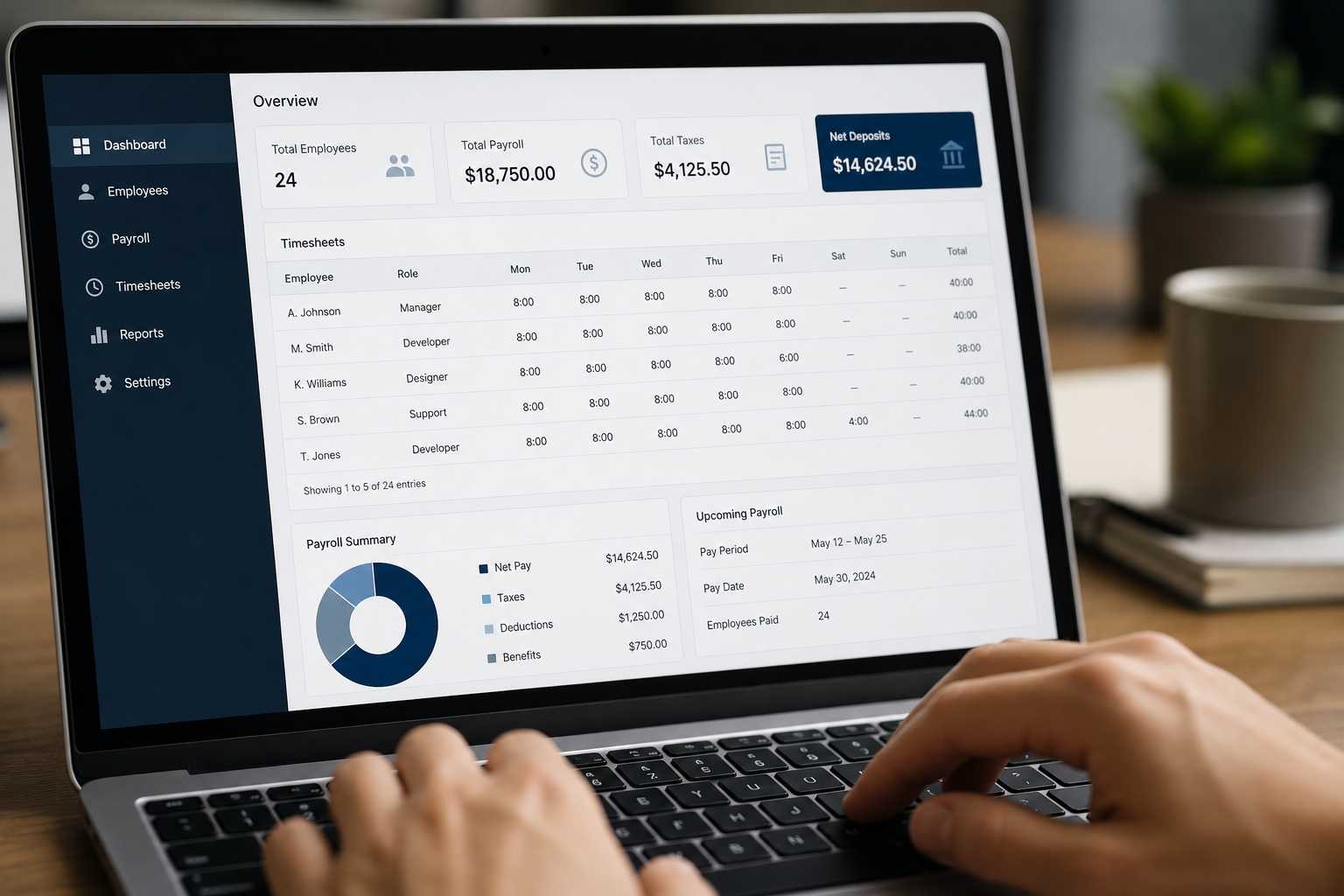
Self-service dashboards let business owners check payroll status between pay runs.
Key Features to Look for in a Minneapolis Payroll Service
Not every payroll service is built the same way. Before signing a contract, business owners should compare providers across a few specific features rather than price alone.
- Direct access: One consistent contact who already knows your business, rather than a ticket queue.
- Compliance credentials: IRS e-file authorization and memberships such as AIPB or NATP.
- Integrated bookkeeping: Payroll numbers that automatically reconcile with the general ledger.
- Technology you can see: A self-service portal for pay stubs, reports, and tax forms.
- Industry experience: Familiarity with your sector's specific compliance rules, such as DHS licensing for care providers.
Notably, the IRS applies escalating failure-to-deposit penalties — from 2% up to 15% of the unpaid amount depending on how late a deposit is made, according to IRS.gov. This is precisely the kind of risk a competent payroll provider should be actively preventing, not just explaining after the fact.
How to Choose the Right Payroll Partner in Minneapolis
Choosing a payroll partner is easier with a clear process. The following steps work for most small and mid-sized Minneapolis businesses, whether they have five employees or fifty.
- Define your payroll complexity: list employee count, pay frequency, benefits, and any out-of-state workers.
- Check compliance credentials, including IRS e-file authorization and professional memberships.
- Ask directly whether you'll get a dedicated contact or a rotating call center queue.
- Review the technology: ask to see the actual payroll dashboard and reporting tools.
- Confirm specialized experience if you run a DHS-licensed program or multi-state operation.
- Request references and start with a free consultation before signing a long-term contract.
For a deeper look at local pricing structures, the guide on how much payroll service costs in Minnesota breaks down typical fee ranges by business size.
Minnesota DHS Providers and Payroll Compliance
Minnesota DHS-licensed providers face a payroll layer that most other businesses never see. Specifically, 245D home and community-based services (HCBS), 245A licensing, and waivered services all intersect with DWRS rate structures and NETStudy 2.0 background study requirements. A new hire who hasn't cleared a background study can trigger payroll and billing complications almost immediately.
Because of this, a payroll provider that understands Minnesota DHS rules can coordinate staffing changes, reevaluations, and corrective action plans without creating gaps in pay or licensing status. HAR Financial Services built this specialty intentionally, supporting DWRS rate audits, appeals, and NETStudy 2.0 compliance alongside day-to-day payroll processing for its home care and PCA clients.

DHS-licensed providers need payroll support that understands background study timing and licensing deadlines.
What to Expect From HAR Financial Services in Minneapolis
HAR Financial Services has operated in Minneapolis since 2006, serving more than 600 clients across Minnesota and Wisconsin, including 240 on active payroll. The firm is BBB accredited, an IRS Authorized E-File Provider, and a member of both AIPB and NATP. In addition, the team has secured over $1,000,000 in grants and loans for clients, alongside running HARpay for payroll and HARbooks for bookkeeping.
Current offers include free catch-up bookkeeping, an accuracy guarantee, and a free consultation with no charge until after that first meeting. Business owners comparing options locally can also review the broader guide to payroll services in Minneapolis or the roundup of top payroll processing companies in Minnesota before deciding. For businesses that also need year-round tax support, the Minneapolis business tax preparation guide covers what to expect beyond payroll. Learn more directly at haraccounting.com.
Common Payroll Mistakes Minneapolis Business Owners Make
Even careful owners fall into a few predictable traps when managing payroll. Recognizing them early can save real money.
- Choosing a provider based on price alone, without checking compliance credentials.
- Not confirming who the actual day-to-day contact will be.
- Missing state-specific filing rules when employees work across Minnesota and Wisconsin.
- Letting payroll and bookkeeping records drift out of sync between systems.
- Waiting until a processor fails, like Kotapay did, instead of asking about a backup plan upfront.
Notably, a brief explanation helps here: a backup plan simply means the provider has already mapped out how it would move clients to a new payroll system without interrupting a single pay cycle. According to Wikipedia's overview of payroll, payroll administration has grown increasingly dependent on specialized software and compliance expertise, which is exactly why this kind of contingency planning matters more than it used to.
Frequently Asked Questions About Minneapolis Business Payroll Provider Options
What is a Minneapolis business payroll provider?
A Minneapolis business payroll provider is a firm that calculates employee wages, withholds and files payroll taxes, and manages direct deposits for local businesses. Many, like HAR Financial Services, also bundle bookkeeping so the payroll numbers and the books always match.
How much does a payroll provider cost in Minneapolis?
Pricing usually depends on employee count and pay frequency, often combining a base monthly fee with a per-employee charge. A detailed breakdown is available in the guide on payroll service costs in Minnesota.
How long does it take to switch payroll providers?
Switching typically takes two to four weeks, depending on how complex the current setup is and how clean the historical records are. Most providers try to align the switch with the start of a new pay period or quarter to simplify reporting.
What is the difference between a bookkeeper and a payroll provider?
A bookkeeper records and reconciles financial transactions, while a payroll provider specifically processes wages, tax withholdings, and payroll filings. Many Minneapolis firms, including HAR, offer both services together so the two stay in sync.
Why do Minneapolis businesses outsource payroll instead of doing it in-house?
Outsourcing lowers the risk of missed tax deposits, late filings, and penalties, while also freeing up the owner's time. It gives smaller businesses access to payroll expertise without the cost of hiring a full-time specialist.
What mistakes do business owners make when choosing a payroll provider?
The most common mistake is picking the cheapest option without checking compliance credentials or how accessible the actual contact person will be. Another is overlooking whether the provider has handled businesses of similar size and industry before.
What credentials should a trustworthy payroll provider have?
Look for IRS Authorized E-File Provider status, professional memberships such as AIPB or NATP, and BBB accreditation. These signal ongoing compliance training and a level of public accountability.
Do Minnesota DHS-licensed providers need a specialized payroll provider?
Yes. 245D and 245A licensed providers deal with payroll considerations tied to DWRS rate structures and NETStudy 2.0 background study timing. A provider unfamiliar with these rules can create compliance gaps that put a license at risk.
Can a Minneapolis payroll provider also handle employees in Wisconsin?
Yes, multi-state payroll providers can manage the different withholding, unemployment insurance, and filing rules for employees in both Minnesota and Wisconsin. This is increasingly common for growing Twin Cities businesses with remote or cross-border staff.
What happens if a payroll processor shuts down unexpectedly?
A strong provider already has a transition plan ready. When the processor Kotapay shut down, HAR migrated all 240 payroll clients to NatPay with zero missed payrolls and zero compliance gaps.
How often should payroll reports be reviewed for accuracy?
Payroll reports should be checked every pay cycle, with a fuller reconciliation each quarter before tax filings are due. This catches small errors before they turn into penalty notices or employee pay disputes.
What is the best way to start with a new payroll provider?
Start with a free consultation and bring recent payroll registers, prior tax filings, and employee records. This lets the provider assess complexity and quote accurate pricing before any work begins.
Quick snapshot: HAR Financial Services has served Minneapolis and Wisconsin businesses since 2006, supporting over 600 clients, 240 of them on active payroll, and securing more than $1,000,000 in grants and loans along the way.
Final Thoughts on Choosing a Minneapolis Payroll Partner
In the end, choosing a Minneapolis business payroll provider comes down to trust, access, and proven compliance history rather than the lowest quoted price. A provider that answers calls personally, understands Minnesota and Wisconsin filing rules, and has a real track record — like migrating 240 payroll clients without a single missed pay run — gives owners one less thing to worry about. Whether a business runs a handful of employees or operates as a licensed DHS provider with specialized needs, the right payroll partner should feel like part of the team, not a vendor on a ticket queue. Booking a free consultation is usually the fastest way to find out whether that fit is there.