
Minnesota Payroll Outsourcing: Complete Guide for 2026
Minnesota payroll outsourcing is the practice of handing payroll processing, tax filings, and compliance work to a specialized firm instead of managing it in-house. For a growing number of small, mid-sized and larger businesses across Minneapolis and greater Minnesota, this shift removes a recurring headache and reduces costly mistakes. Payroll rules change often, deadlines are strict, and a single missed filing can trigger penalties from the state or the IRS. Consequently, owners who once handled payroll themselves often reach a point where the risk of doing it wrong outweighs the cost of paying someone else to do it right.
Quick answer: Minnesota payroll outsourcing means paying a bookkeeping or payroll firm to run pay cycles, withhold and deposit taxes, and stay current with state and federal rules on your behalf. It typically costs a few hundred dollars a month and removes the risk of missed filings or payroll errors.
What Is Minnesota Payroll Outsourcing?
In short, Minnesota payroll outsourcing is when a business transfers payroll processing, tax deposits, and reporting duties to an outside accounting firm. The firm calculates gross pay, withholds federal and state taxes, deposits those amounts on schedule, and files the required quarterly and annual returns.
Beyond the mechanics, a good provider also tracks Minnesota-specific rules such as unemployment insurance rates, paid leave requirements, and any industry licensing tied to staffing. As a result, the business owner gets a finished, compliant payroll cycle without touching a tax form.
Why Minnesota Businesses Choose to Outsource Payroll
Most business owners do not start out planning to outsource payroll in Minnesota. Instead, they reach a breaking point. A spreadsheet that worked for three employees starts failing at fifteen. A missed deposit deadline results in an unexpected IRS penalty. In addition, staff turnover means nobody in the office fully understands how the last payroll run was calculated.
The IRS notes that businesses can face escalating penalties for late payroll tax deposits, with rates that climb the longer a deposit is overdue, according to IRS guidance on employment taxes. That single fact drives much of the demand for outsourcing, because the cost of a mistake can quickly exceed a year of provider fees.
Regulatory complexity adds another layer. Minnesota employers must track state withholding tables published by the Minnesota Department of Revenue, plus unemployment insurance obligations that shift year to year. For businesses in regulated fields, such as DHS-licensed home care providers, payroll intersects directly with licensing compliance, which is why specialized support matters. Firms like HAR Financial Services, described in more detail at haraccounting.com, build their payroll process around these overlapping requirements.

Reviewing payroll records is a core part of Minnesota payroll outsourcing before any pay run goes live.
How Minnesota Payroll Outsourcing Works, Step by Step
While every provider handles onboarding slightly differently, the general process for outsourcing payroll in Minnesota follows a predictable sequence. Understanding these steps helps owners set realistic expectations before signing on with a new firm.
Consultation and payroll audit. The provider reviews current employee counts, pay schedules, benefit deductions, and past filings to spot gaps or compliance risks before anything changes.
Data migration and account setup. Employee records, tax identification numbers, direct deposit details, and historical payroll data move into the new system without interrupting active pay cycles.
Compliance verification. The team confirms unemployment insurance accounts, withholding tables, and any licensing coordination are correctly set up before the first live payroll run.
Ongoing processing and reporting. The provider runs payroll each cycle, files tax deposits on time, and delivers reports so owners can track labor costs without doing the math themselves.
Notably, the transition itself is often the biggest fear owners have. HAR Financial Services migrated 240 active payroll clients to a new processor after its previous vendor shut down, completing the switch with zero missed payrolls and zero compliance gaps. That track record is a useful benchmark when evaluating whether a provider can handle a transition without disruption.
What Does Payroll Outsourcing Cost in Minnesota?
Cost is usually the first question owners ask, and understandably so. Pricing varies by employee count, filing frequency, and whether payroll is bundled with bookkeeping or tax services. For a deeper walkthrough, see our Fractional CFO Minneapolis: Services & Pricing Guide.
Service | Typical Monthly Range |
|---|---|
Payroll only | Around $200 |
Bookkeeping only | Around $500 |
Bundled payroll and bookkeeping | Around $700 |
Annual tax filing | Around $1,400 per filing |
These figures reflect typical Minneapolis-area engagements. Although the numbers vary by firm, they give a useful baseline for budgeting. Compared with the salary, benefits, and software cost of an in-house payroll hire, outsourcing is often the more affordable path for businesses under fifty employees.
Minnesota Payroll Outsourcing vs. In-House Payroll
Some owners assume keeping payroll in-house gives them more control. In practice, the opposite is often true, because in-house payroll depends on one person staying current with every rule change. For a deeper walkthrough, see our Payroll Companies MN: How to Pick the Right One for You.
In-house payroll requires ongoing software subscriptions, staff training, and someone accountable when the state changes a withholding table. Outsourced payroll, on the other hand, shifts that burden onto a firm whose entire job is staying current. Furthermore, an outsourced provider typically catches errors before they become penalties, since reviewing payroll accuracy is part of their daily routine rather than an occasional task.
That said, outsourcing works best when the provider offers direct access to the person handling the account, not a rotating call center. This is one reason business owners specifically look for local firms with a physical office, such as the setup described in this guide to payroll services in Minneapolis. For a deeper walkthrough, see our Payroll Services Minneapolis: A Guide for Small Business.
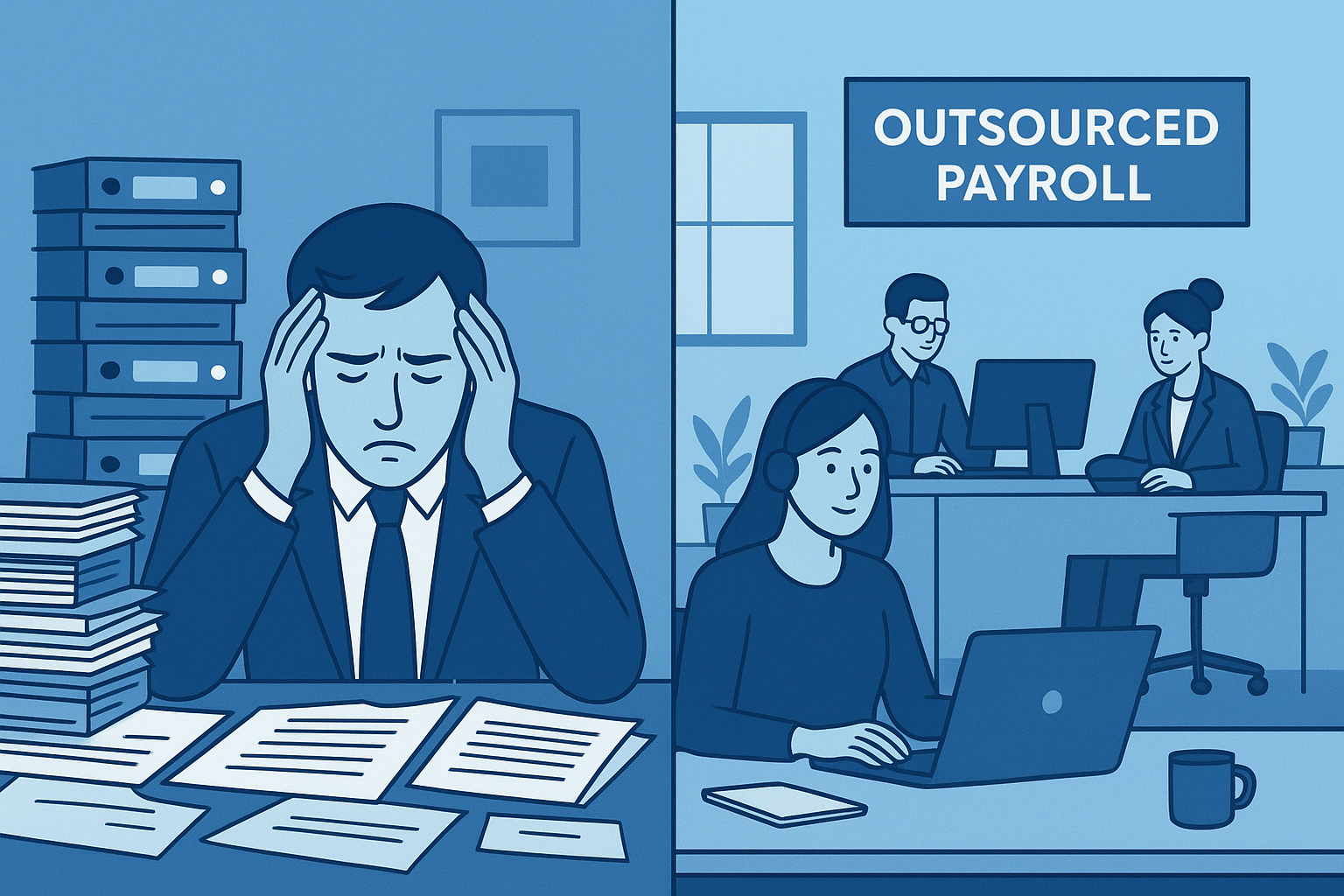
In-house payroll often creates more manual work than a well-run Minnesota payroll outsourcing arrangement.
Compliance Considerations for Minnesota Employers
Compliance is where outsourcing pays for itself most clearly. Minnesota employers must register for unemployment insurance, withhold state income tax correctly, and file quarterly reports on time. Missing any of these steps can trigger fines regardless of business size.
For businesses operating under DHS licensing, such as 245D and 245A waivered service providers, payroll connects directly to licensing compliance. Background study requirements under NETStudy 2.0, staffing ratio documentation, and DWRS rate reporting all depend on accurate payroll records. A generic payroll vendor rarely understands these overlaps, which is why specialized guidance matters. Businesses in this category can review more detail in this breakdown of 245D services and DHS compliance support.
According to the U.S. Small Business Administration, employers are responsible for maintaining accurate payroll and tax records regardless of who processes them. In other words, outsourcing reduces risk, but the business still needs a provider it can trust to keep those records audit-ready.
Choosing the Right Minnesota Payroll Outsourcing Partner
Not every provider is a good fit for every business. Above all, look for direct access to the person handling your account rather than a ticket queue. A local, physical office adds a layer of accountability that fully remote or offshore teams often cannot match.
Industry depth matters just as much as price. A provider that already understands DHS licensing, multi-state withholding, or grant compliance will save far more time than the cheapest option on the market. For a broader comparison of firms serving the state, this guide to choosing an accounting firm in Minnesota outlines the key criteria to weigh before signing a contract. For a deeper walkthrough, see our Minnesota Grant Application Accounting: Complete Guide.
HAR Financial Services, based in Minneapolis at 2304 Park Ave S, has worked with small, mid-sized and larger businesses since 2006. The firm currently supports roughly 600 clients, including 240 on active payroll, and keeps most of its team working in person rather than through an offshore call center. More background on the firm's services is available on the HAR Financial Services home page and at www.haraccounting.com.
A Real Example: Migrating 240 Payroll Clients Without a Missed Paycheck
When HAR's previous payroll processor, Kotapay, announced it was shutting down, 240 active payroll clients faced immediate risk of disrupted pay cycles. Rather than treat this as a crisis, the firm managed a full migration to a new processor, NatPay, across every affected account.
The result was zero missed payrolls and zero compliance gaps across all 240 clients. This example matters because the single biggest objection to switching payroll providers is fear of disruption during the transition. A firm that has already executed a migration at that scale, under deadline pressure, has demonstrated it can handle the process without failure.

Careful coordination is what keeps Minnesota payroll outsourcing transitions free of missed pay dates. For a deeper walkthrough, see our How Much Does Payroll Service Cost in Minnesota?.
Frequently Asked Questions About Minnesota Payroll Outsourcing
What is Minnesota payroll outsourcing?
Minnesota payroll outsourcing is the practice of hiring an outside firm to run payroll, file payroll taxes, and manage related compliance instead of handling those tasks with in-house staff. The provider processes pay each cycle, submits required deposits, and keeps records ready for audits. For a deeper walkthrough, see our Minnesota DHS Provider Accounting: Compliance Guide 2026.
How much does payroll outsourcing cost in Minnesota?
Pricing typically runs a few hundred dollars per month depending on employee count and service depth. For example, standalone payroll runs around $200 per month for many small Minnesota businesses, while bundled bookkeeping and payroll packages average closer to $700 per month. For a deeper walkthrough, see our Mid-Sized Business Bookkeeping Minnesota: Complete Guide.
How long does it take to switch payroll providers in Minnesota?
A typical transition takes two to four weeks, covering data migration, tax ID verification, and a test payroll run. Firms with proven migration experience can move large client bases without missing a single pay date.
What is the difference between payroll outsourcing and payroll software?
Payroll software is a tool the business still operates and troubleshoots itself, while outsourcing hands the entire process, including compliance decisions, to trained professionals. Outsourcing adds human judgment for tricky situations like garnishments, multi-state filings, or licensing-linked payroll rules.
Is payroll outsourcing worth it for a small business?
For most businesses with more than a handful of employees, outsourcing is worth it because it reduces penalty risk and frees the owner's time. Once payroll complexity grows beyond a few employees, the hours saved and errors avoided usually outweigh the monthly fee.
What mistakes do businesses make when outsourcing payroll?
Common mistakes include not verifying a provider's experience with Minnesota-specific tax rules, skipping a trial payroll run, and failing to confirm who has direct access to the account. Businesses also sometimes overlook licensing-related payroll requirements in regulated industries.
Can a Minnesota payroll outsourcing provider handle multi-state employees?
Yes, experienced providers manage multi-state withholding, unemployment insurance registrations, and reciprocal tax agreements between Minnesota and neighboring states like Wisconsin. This matters for businesses with remote staff or locations on both sides of the border.
Do DHS-licensed providers need specialized payroll support?
Yes, 245D and 245A licensed home care and waivered service providers face payroll rules tied to background studies, staffing ratios, and DWRS rate reporting. A generic payroll vendor often misses these industry-specific requirements.
What happens to my payroll data if I switch providers?
A qualified provider migrates historical payroll records, tax filings, and employee information securely before the first live run. Reputable firms verify every data point against prior filings so nothing is lost in the transition.
How often does Minnesota payroll tax law change?
State withholding tables, unemployment insurance rates, and paid leave requirements are reviewed and can change annually. Outsourcing shifts the burden of tracking these updates onto a firm that monitors them as part of its core work.
What should I look for when choosing a payroll outsourcing partner?
Look for direct access to the person handling your account, a track record of accurate filings, and experience in your specific industry. A local office you can visit adds accountability that fully remote or offshore providers often cannot match.
Will Minnesota payroll outsourcing disrupt my current pay schedule?
A well-managed transition should not disrupt pay dates at all. HAR Financial Services migrated 240 payroll clients to a new processor with zero missed payrolls, showing that a careful process can protect continuity even under a tight deadline.
Final Thoughts on Minnesota Payroll Outsourcing
Ultimately, Minnesota payroll outsourcing is less about giving up control and more about transferring risk to a team built for it. Owners who make the switch typically gain back hours each month, reduce the odds of a costly penalty, and get financial reporting they can actually use to run the business.
Whether a business needs simple pay processing or deeper compliance support tied to DHS licensing, choosing a provider with local accountability and industry depth makes the transition smoother. Businesses ready to compare options can start with a free consultation at HAR Financial Services before committing to a new payroll partner.