Home care business accounting services give Minnesota and Wisconsin home care agencies the specialized bookkeeping, payroll and compliance support they need to survive DHS audits, DWRS rate reviews and the day-to-day chaos of running a licensed care business. If you operate a 245D, 245A, PCA or waivered services program, generic accounting software and a once-a-year tax preparer simply are not built for your licensing requirements. In particular, this guide breaks down what specialized accounting actually covers and how to choose the right partner.
Direct answer: Home care business accounting services combine standard bookkeeping and payroll with Minnesota DHS-specific compliance work, including 245D and 245A licensing support, DWRS rate audits, NETStudy 2.0 background study tracking, and cost reports built to satisfy DHS auditors and lenders. The goal is accurate, licensing-ready books, not just a tax return once a year.

Accurate books are the foundation of reliable home care business accounting services.
What Is Home Care Business Accounting Services?
Home care business accounting services is the term for bookkeeping, payroll and financial compliance work tailored to licensed home care and HCBS (home and community-based services) agencies. Unlike general small business accounting, it accounts for Medicaid waiver billing cycles, DHS licensing documentation and staff-specific payroll rules.
In practice, that means monthly reconciliation, payroll processing for direct support staff, DWRS cost reporting and support during reevaluations or corrective action plans. According to the U.S. Bureau of Labor Statistics, employment of home health and personal care aides is projected to grow much faster than average over the coming decade, which means more agencies will need accounting systems built for scale, not spreadsheets.
Why Home Care Agencies Need Specialized Bookkeeping
A standard bookkeeper can record transactions, but a Minnesota home care agency needs more than clean ledgers. Specifically, licensed providers face recurring DHS reevaluations, periodic DWRS rate audits and background study compliance under NETStudy 2.0, all of which depend on well-organized financial records.
Consequently, agencies that treat accounting as an afterthought often scramble when a reevaluation notice arrives. By contrast, firms that build healthcare accounting for DHS-licensed providers into daily operations stay audit-ready year-round rather than panicking every few years.
DHS Compliance and DWRS Rate Support
DWRS, short for the Disability Waiver Rate System, sets Medicaid reimbursement rates using reported cost and staffing data. As a result, inaccurate or incomplete cost reports can lower an agency's rate or trigger a DWRS audit. Accountants familiar with the Minnesota Department of Human Services framework structure the chart of accounts so cost reports and appeals can be produced quickly and accurately.
Payroll for PCA and Waivered Services Staff
Payroll for personal care assistants and waivered services staff has to track hours by client and service code, apply overtime correctly, and file Minnesota and federal withholding on time. HAR processes payroll through its own platform, HARpay, for 240 active payroll clients across Minnesota and Wisconsin, which keeps records aligned with DHS documentation needs rather than treated as a separate system.
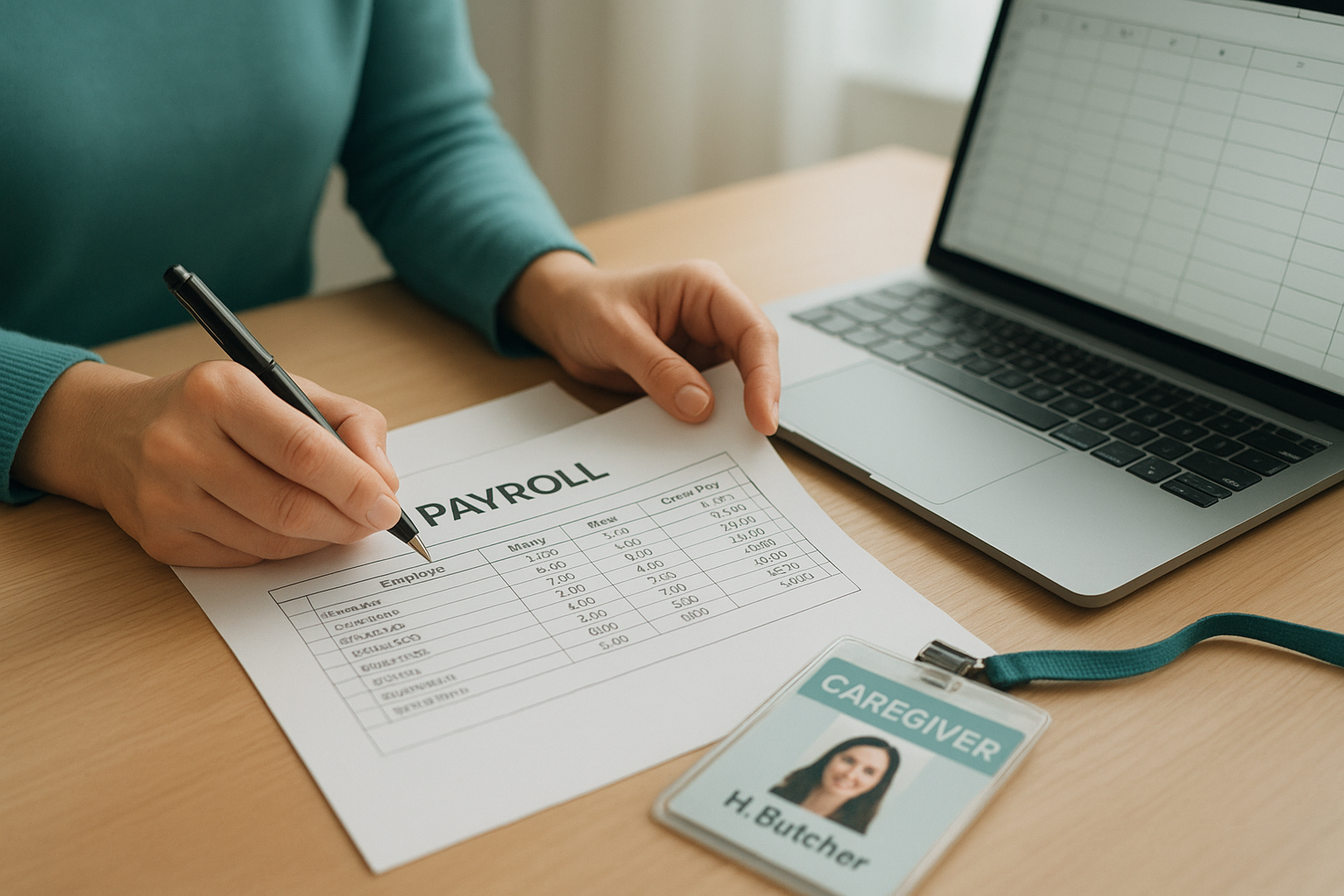
Accurate payroll keeps home care agencies compliant with Minnesota wage and hour rules.
How to Set Up Reliable Accounting for a Home Care Business
Building a compliant accounting system does not happen overnight, but it follows a predictable sequence. The following steps reflect how most Minnesota home care agencies move from reactive bookkeeping to an audit-ready system.
- Separate business and personal finances. Open a dedicated business checking account and payroll account so every reimbursement and expense is traceable.
- Build a DHS-ready chart of accounts. Map income and expense categories directly to DWRS cost reporting fields to avoid manual reclassification later.
- Implement compliant payroll for care staff. Track hours by client and service code, apply correct overtime rules, and file withholding on schedule.
- Prepare cost reports for DWRS and audits. Generate monthly summaries that leave a clean trail from source documents to reported totals.
- Schedule monthly reconciliation and review. Reconcile every account monthly and review KPIs quarterly so reevaluations never catch the agency off guard.
If your books are already months behind, this sequence still applies, but it usually starts with catch-up bookkeeping services to reconstruct missing months before any audit prep begins.
Choosing a Home Care Accounting Partner That Understands DHS
Not every accounting firm understands 245D licensing or DWRS appeals, so it helps to ask direct questions before signing on. For example, ask how many licensed home care clients the firm currently serves, whether they have handled a DWRS rate appeal, and who will actually answer the phone when a question comes up.
HAR Financial Services has worked with Minnesota's home care community since 2006, serving over 600 clients across Minnesota and Wisconsin, with 240 on active payroll through HARpay. The firm is BBB accredited, holds an active IRS e-file authorization, and its staff are members of the AIPB and NATP professional associations. Learn more about what sets HAR apart from firms that treat home care clients like every other small business.
Why Payroll Reliability Matters for Home Care Agencies
Payroll disruptions hit home care agencies harder than most businesses because caregivers depend on consistent, on-time pay to keep working with vulnerable clients. When the payroll processor Kotapay shut down, HAR migrated all 240 payroll clients to NatPay with zero missed payrolls and zero compliance gaps. For a closer look at the difference between a locally managed system and a call-center model, see how HAR compares to national payroll providers.
Common Bookkeeping Mistakes Home Care Agencies Make
Even well-run agencies fall into a handful of predictable traps. First, mixing personal and business accounts makes DWRS cost reporting nearly impossible to untangle later. Second, misclassifying contract caregivers as employees, or the reverse, creates payroll tax exposure that surfaces during an IRS or state review.
Third, many agencies wait until a reevaluation notice arrives to organize their records, rather than maintaining audit-ready books year-round. For broader guidance beyond home care specifically, HAR's ongoing business accounting support page outlines the monthly habits that prevent these issues across any growing Minnesota business. The IRS Small Business and Self-Employed Tax Center is also a useful reference for worker classification rules.
Beyond Bookkeeping: Grants, Loans and CFO Support
Accounting support does not stop at reconciliation. Many home care agencies also need help applying for SBA loans or local grant programs, and HAR has secured more than $1,000,000 in grants and loans for its Minnesota and Wisconsin clients. The U.S. Small Business Administration offers additional background on loan programs that home care owners may qualify for.
Similarly, once an agency outgrows basic bookkeeping, fractional CFO advisory brings cash flow forecasting and KPI tracking into the picture. Owners can explore HAR's full range of services and book a consultation directly at haraccounting.com.
In-person support from a local Minneapolis office, not a call center.
Frequently Asked Questions
What are home care business accounting services?
Home care business accounting services are bookkeeping, payroll and compliance support designed specifically for licensed home care agencies, including 245D, 245A, PCA and waivered services providers. They cover DHS-ready financial reporting, DWRS cost reporting, payroll for care staff, and ongoing reconciliation, not just annual tax filing.
How much does it cost to hire an accountant for a home care agency?
Costs vary based on client volume, payroll headcount and whether DWRS or licensing support is included. HAR Financial Services offers a free consultation before any fee is charged so owners can see the scope first.
Why do home care providers need DHS-specific accounting support?
DHS auditors and cost report reviewers expect specific documentation that generic bookkeeping does not produce automatically. A specialized accountant builds the chart of accounts, payroll records and cost reports to match DHS and DWRS requirements from the start.
How long does it take to catch up on late bookkeeping for a home care business?
Timelines depend on how many months are unreconciled, but agencies with six to twelve months of backlog can often be brought current within two to six weeks. Free catch-up reviews typically start with a full transaction and bank statement audit.
What is DWRS and how does it affect home care agency accounting?
DWRS, the Disability Waiver Rate System, sets Medicaid waiver reimbursement rates for Minnesota HCBS providers based on reported costs and staffing data. Inaccurate cost reporting can lower an agency's rate or trigger an audit.
How does payroll work for home care agencies with PCA or waivered services staff?
Payroll must track hours by client and service code, handle overtime rules, and file Minnesota and federal withholding correctly. A platform like HARpay processes direct deposit and tax filings while keeping records aligned with DHS documentation needs.
What is NETStudy 2.0 and how does it relate to accounting compliance?
NETStudy 2.0 is Minnesota's background study system that licensed providers must use to clear staff before unsupervised work with clients. It is a licensing requirement, but payroll and HR teams often coordinate onboarding timelines around it.
What's the difference between a bookkeeper and a CFO advisor for a home care business?
A bookkeeper records transactions and reconciles accounts to keep historical financials accurate. A fractional CFO advisor uses those numbers to forecast cash flow, set KPIs and guide bigger decisions like opening a new location.
What are the most common bookkeeping mistakes home care agencies make?
The most common mistakes include mixing personal and business accounts, misclassifying contract caregivers as employees, and failing to reconcile DHS reimbursement deposits monthly. Each one can create problems during a DWRS audit.
How often should a home care business reconcile its books?
Monthly reconciliation is the minimum standard for a licensed home care agency, and weekly review of payroll and reimbursement deposits is recommended as staff counts grow. Waiting until tax season makes errors much harder to trace.
Can a home care business get help with grants or SBA loans?
Yes, many accounting firms that work with home care agencies also manage SBA and community lender applications and grant monitoring. HAR Financial Services has secured more than one million dollars in grants and loans for Minnesota and Wisconsin clients.
What documents do I need before my first accounting consultation?
Bring recent bank and payroll statements, DHS license documentation, last year's tax return and any outstanding DWRS correspondence. Having these ready lets the accountant scope the work accurately at the first meeting.
How do I switch accounting providers without disrupting payroll?
A well-managed transition runs both systems in parallel for one payroll cycle so no deposits or tax filings are missed. HAR migrated all 240 of its payroll clients from Kotapay to NatPay with zero missed payrolls, which is the standard to expect.
Key Takeaways
Ultimately, home care business accounting services are not optional for Minnesota DHS-licensed providers juggling DWRS audits, NETStudy compliance and multi-client payroll. Instead of treating accounting as a once-a-year task, agencies that build reconciliation, payroll accuracy and licensing-ready cost reports into their monthly routine are the ones that pass reevaluations without scrambling. Whether you need catch-up bookkeeping, HARpay payroll, or full DHS compliance support, choosing an accounting partner who already understands Minnesota's home care landscape makes the difference between reactive paperwork and a financially stable agency.